

Smart Building & Energy Management
One intelligent platform for energy, climate, lighting and building automation.
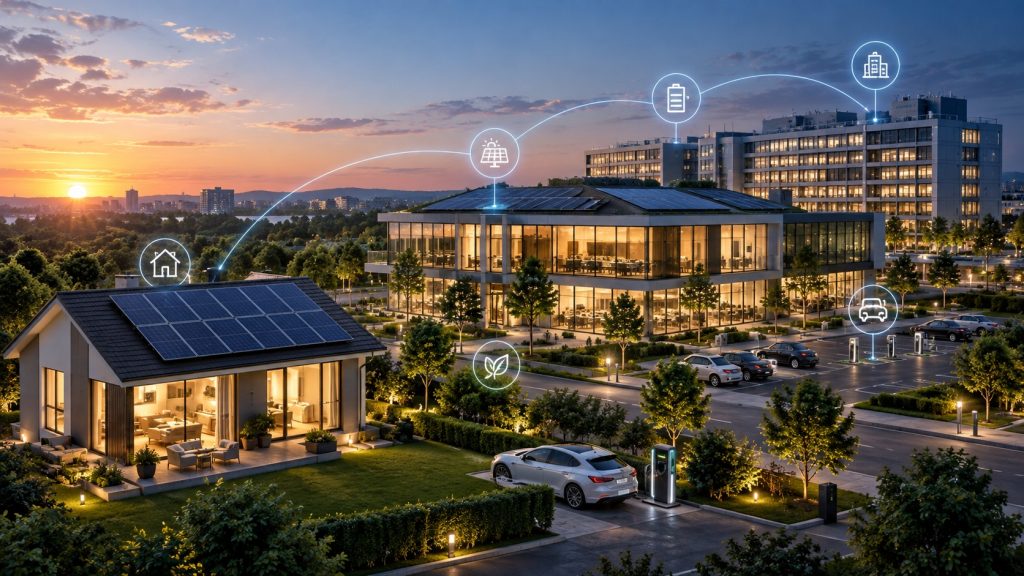
One Platform for the Whole Building
Lite Lion brings Smart Building & Energy Management together in one flexible, learning and predictive system.
From a single-family home to apartment buildings, commercial properties and multi-site installations, the same platform can monitor, control and optimize the systems that determine how a building operates every day.
Instead of building a smart property from a collection of unrelated applications, cloud services and proprietary controllers, Lite Lion provides a common environment for energy, heating, climate, lighting, sensors, relays, automation, history, alarms and professional supervision.
And a Home user is not given a deliberately stripped-down version of the technology. The scale of the installation may be smaller, but the platform is designed to grow with the property.
Start with a few sensors and relays. Add advanced lighting. Connect heating. Add solar generation and battery storage. Introduce dynamic electricity prices and predictive energy management.
The system can grow without having to start again.
Start Small. Build as Far as You Want.
A genuinely useful smart home does not have to begin with an expensive installation.
A Lite Lion Home license, a suitable gateway, a few temperature and humidity monitoring units and a relay module already provide an excellent foundation for a modern smart home.
That relatively simple starting point can provide monitoring, history, alarms, scheduled control and automated functions. From there, the installation can expand step by step.
Possible functions include:
- Temperature and humidity monitoring
- Room-specific monitoring and setpoints
- Heating and climate control
- Relay-controlled equipment
- Timers and schedules
- Sensor-based automation
- Energy monitoring
- Solar PV monitoring and management
- Battery storage management
- Dynamic electricity price optimization
- Grid charging
- Load management
- Peak-power management
- Grid import and export monitoring
- EV Charging & Load Management
- Lighting control
- Dimming
- Tunable white / CCT
- RGB and RGBW lighting
- Lighting scenes
- Circadian lighting
- DALI
- Modbus lighting
- DMX / Art-Net
- Technical alarms
- Historical charts
- Operational reports
- Remote supervision
There is no need to predict every future requirement when the first equipment is installed.
Build what you need now and expand when a new idea, room, energy system or automation requirement appears.
Intelligent Energy Management
Lite Lion is designed to do considerably more than display electricity consumption.
Its energy management environment can combine information from electricity consumption, solar production, battery storage, grid power, dynamic electricity prices, weather and production forecasts, historical behaviour and configurable property limits.
Depending on the installed equipment and available measurements, the system can monitor and manage:
- Real-time electricity consumption
- Quarter-hour energy behaviour
- Solar PV production
- Battery State of Charge
- Battery charging and discharging
- Grid import
- Grid export
- Dynamic electricity prices
- Grid charging during advantageous periods
- Battery use during expensive periods
- Maximum grid import
- Site power limits
- Peak-power limitation
- Solar self-consumption
- Battery utilization
- Energy costs
- Historical consumption
- Historical production
- Energy flows
- Daily energy behaviour
- Longer-term consumption patterns
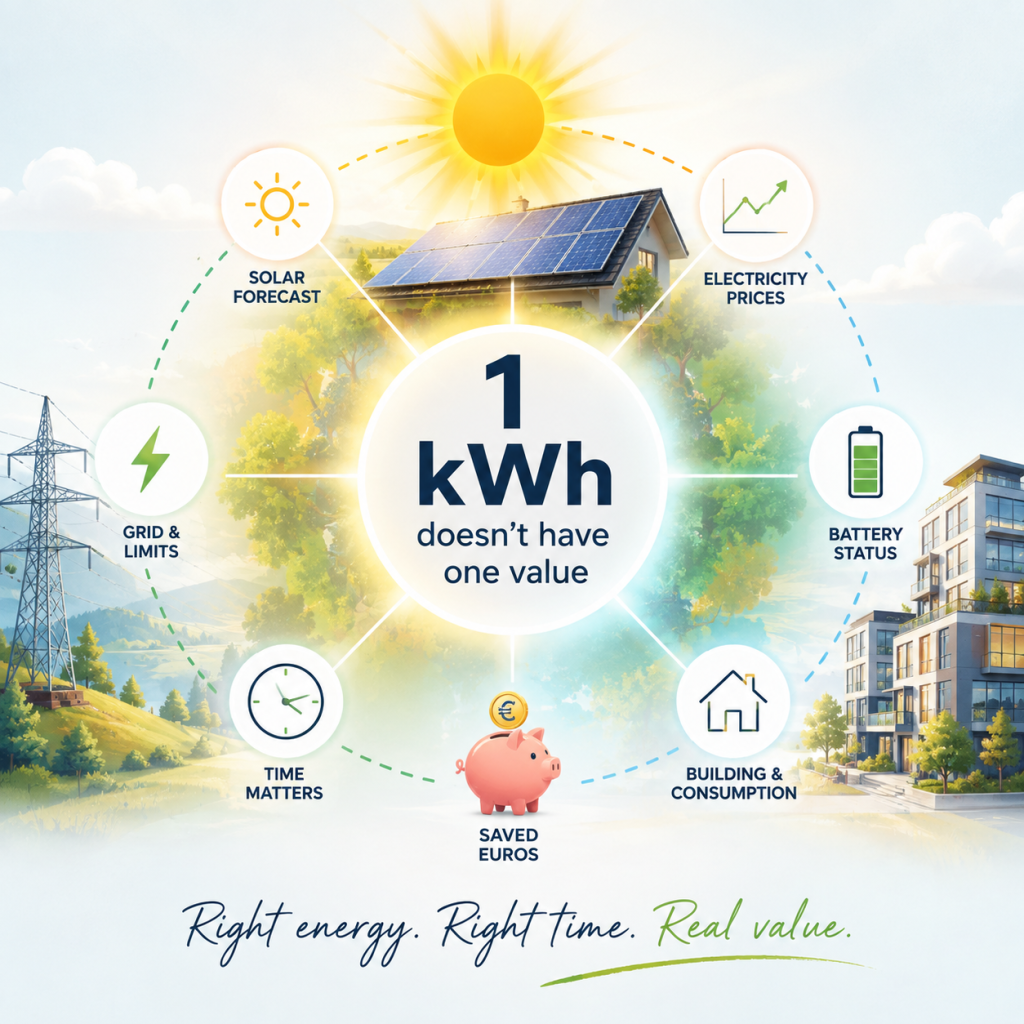
The objective is not simply to maximize solar production or cycle a battery whenever possible.
The important questions are:
- When will energy be needed?
- Where should it come from?
- When should it be stored?
- When should stored energy be preserved?
- What will that energy probably be worth later?
- That changes energy management from simple reaction into planning.
- EV Charging & Load Management
- Lite Lion can integrate EV charging into the building’s complete energy management system. Monitor individual charging points, energy consumption and charging costs, create parking-space-specific reports, and use charger data or independent energy meters. Charging can be coordinated with dynamic electricity prices, solar production, battery storage, building load and maximum grid power. Predictive control can also work towards a required energy level by a selected departure time.
Learning, Prediction and Long-Term Forecasting
Buildings are continuously changing systems.
Their behaviour varies with time of day, season, outdoor conditions, occupancy, solar radiation, electricity prices and the way people actually use the property.
A fixed set of timer rules can automate a building.
It cannot truly understand how that building behaves.
Lite Lion is therefore being developed around a combination of real-time measurements, historical data, external forecasts, learned building behaviour and predictive control.
The principle is:
Real-time measurements + Building history + External forecasts + Learned behaviour → Predictive control
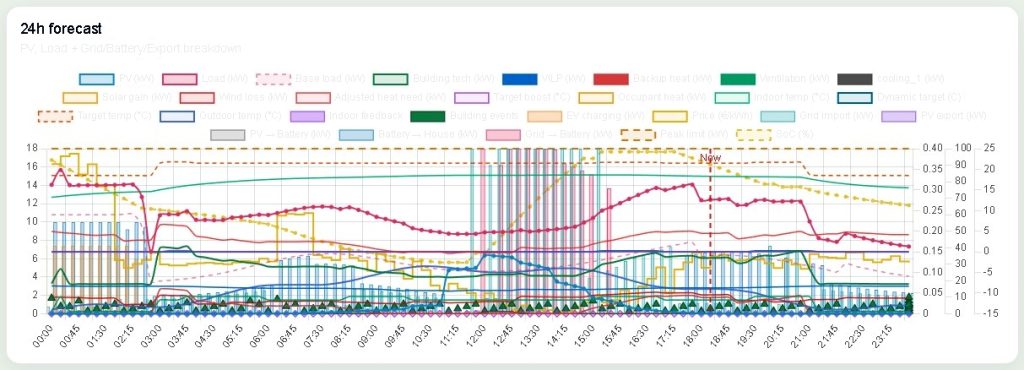
Short-term prediction can help the system prepare for the coming hours and days.
Longer-term forecasting can reveal seasonal changes, evolving consumption patterns and changes in the energy behaviour of the property.
Over time, the system can build an increasingly useful picture of questions such as:
- When does this building normally consume energy?
- How does consumption change between weekdays and weekends?
- How does demand change with outdoor conditions?
- How quickly does a room normally heat or cool?
- How does the building react to heating adjustments?
- When is solar production normally available?
- When is stored energy likely to become more valuable?
- Which loads create recurring power peaks?
- What is normal behaviour for this property?
- Which changes represent a genuine deviation?
- Are consumption patterns gradually changing?
- Are particular rooms, apartments or systems repeatedly causing problems?
The goal is not to attach an “AI” label to ordinary automation.
The goal is more practical:
Make tomorrow’s control decisions better by using what the building taught us yesterday, what is happening now and what available forecasts tell us about what comes next.
Predictive Solar, Battery and Electricity Price Optimization
Solar production, battery storage and dynamic electricity prices become much more useful when they are managed together.
A conventional battery strategy may simply charge from surplus solar generation and discharge whenever consumption exceeds PV production.
That works, but it does not necessarily produce the best economic result.
Lite Lion can consider the time value of energy.
Depending on the available information and configuration, energy may be:
- Used immediately
- Stored
- Preserved for later
- Imported from the grid
- Charged into the battery from the grid
- Exported
- Reserved for an expected expensive period
For example, using battery energy immediately may not be advantageous if inexpensive grid electricity is available now and substantially more expensive electricity is expected later.
Likewise, charging a battery from the grid can make sense when the expected future value of that stored energy exceeds the cost of charging it, including losses.
Solar energy also has a time value. Storing it may be advantageous, but exporting it can sometimes be the better choice.
Predictive control allows the system to look forward rather than simply respond to the present quarter-hour.
Heating & Climate Management
Heating is one of the largest energy consumers in many buildings and should not operate as an isolated island.
Lite Lion provides a common environment for monitoring and managing indoor conditions and heating systems.
Depending on the installation, functions can include:
- Room temperature monitoring
- Humidity monitoring
- Individual room setpoints
- Apartment-level climate monitoring
- Heating circuit monitoring
- Supply temperatures
- Return temperatures
- Domestic hot water monitoring
- Heating energy consumption
- Temperature history
- Humidity history
- Setpoint history
- Heating and climate alarms
- Long-term trend analysis
- Room-level reporting
- Apartment-level reporting
- Building-level reporting
A building is not one temperature.
Bedrooms, living rooms, bathrooms, offices and technical spaces can all have different requirements.
Lite Lion therefore supports a natural hierarchy:
Site → Building → Apartment → Room
This becomes particularly useful in apartment buildings and commercial properties, where conditions need to be understood at several levels rather than reduced to one building-wide number.
History Turns Measurements Into Information
A sensor reading tells you what is happening now.
History tells you whether it is normal.
Lite Lion can retain operational information and present it through charts and reports, allowing homeowners, installers and professional operators to see how a property behaves over time.
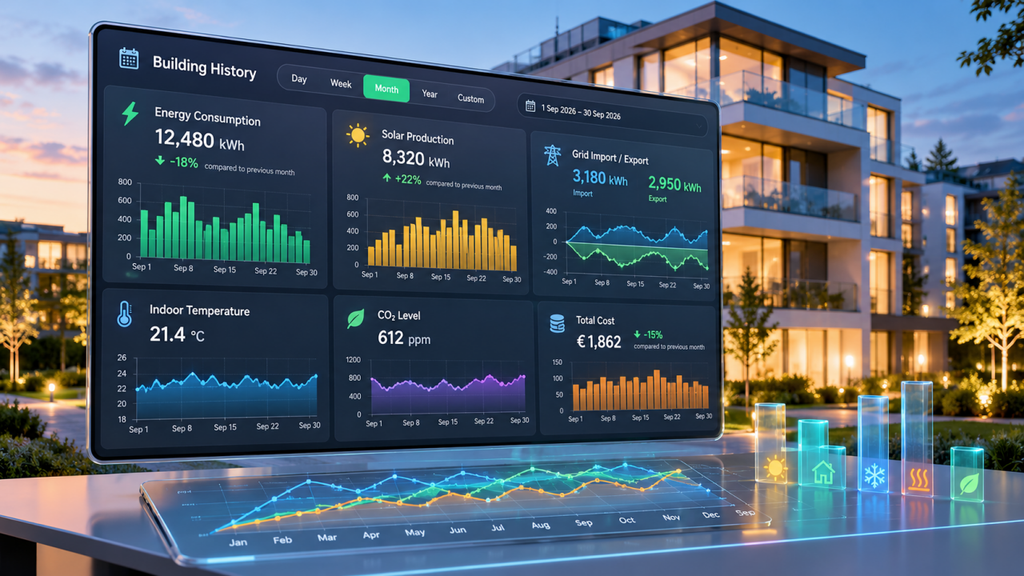
Historical information can reveal:
- Unusual energy consumption
- Gradual changes in consumption
- Recurring power peaks
- Heating performance
- Temperature deviations
- Rooms that heat or cool differently
- Solar production patterns
- Battery behaviour
- Indoor climate trends
- Equipment operation
- Repeated alarms
- Long-running faults
- Effects of configuration changes
- Seasonal differences
This history also provides valuable input for learning and predictive functions.
The longer a building operates, the richer its operational fingerprint can become.
Lighting Without the Controller Jungle
Lighting is one of the areas where smart-building installations can quickly accumulate unnecessary boxes.
One controller for dimming. Another for tunable white. Another for RGB. Another for RGBW. Yet another ecosystem for scenes.
Lite Lion takes a different approach.
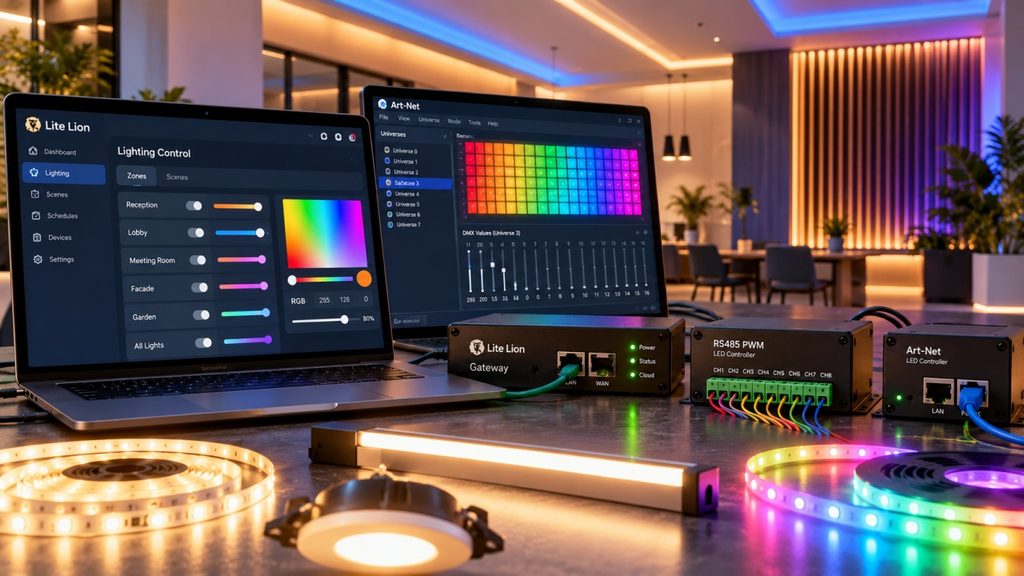
The Lighting Engine separates the desired lighting behaviour from the physical interface used to create it.
Depending on the installed hardware, the platform can support:
- ON/OFF lighting
- Dimming
- PWM control
- CCT / tunable white
- RGB
- RGBW
- Fader functions
- Colour cycles
- Continuous fading
- Lighting scenes
- Scheduled lighting
- Sunrise and sunset scheduling
- Sensor-controlled lighting
- Morning transitions
- Evening transitions
- Circadian lighting
- Ambient lighting
- Entertainment scenes
- DALI
- Modbus-controlled lighting
- DMX / Art-Net integration
The same conceptual lighting function can therefore be mapped to the hardware that suits the project.
This can dramatically reduce unnecessary specialized equipment.
A multi-channel PWM interface combined with suitable standard LED amplifiers can serve several different lighting applications instead of requiring a separate proprietary smart controller for each one.
And when a project requires professional lighting equipment, DMX / Art-Net can bring those fixtures into the same automation environment.
The scene describes what the light should do. The interface determines how the command reaches the light.
That distinction makes the lighting system exceptionally flexible.
Automation Beyond the Big Systems
Not every useful automation function needs a sophisticated dedicated controller.
Many building functions ultimately need something quite simple:
- Measure something.
- Compare it with a condition.
- Switch something.
- Dim something.
- Run something according to a schedule.
- Report if something goes wrong.
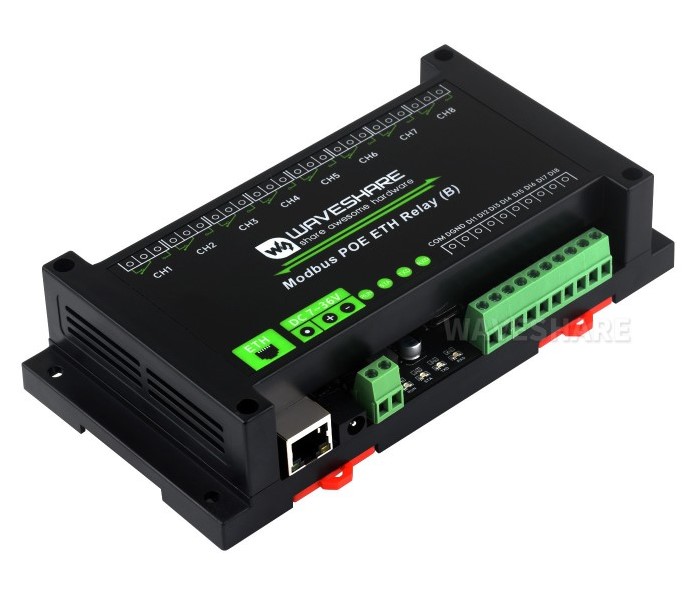
Modbus I/O, relay modules, sensors and configurable control channels allow many ordinary building functions to become part of the same automation environment.
Applications can include:
- Pumps
- Fans
- Ventilation-related equipment
- Electric heating
- Water heaters
- Auxiliary heaters
- Indoor lighting
- Outdoor lighting
- Temperature-controlled equipment
- Timed loads
- Contact inputs
- Equipment status signals
- Technical alarms
- Door signals
- Level switches
- Other ON/OFF controlled equipment
Functions can be based on manual commands, schedules, sensor values, temperatures or other information available to the system.
Standard Technologies Instead of a Closed Hardware Island
A building automation platform should not require every sensor, relay and interface to carry the same manufacturer’s logo.
Lite Lion is designed around widely used technologies such as:
Modbus RTU • RS485 • Modbus TCP • Ethernet • Standard I/O • PWM • DALI • DMX / Art-Net
This allows hardware to be selected according to the actual engineering requirement.
Our Automation Hardware range supports this approach with products such as:
- Modbus I/O modules
- RS485 & Modbus gateways
- Relay modules
- PWM & lighting interfaces
- Temperature and humidity sensors
- Other sensors & transmitters
- Communication modules
- Power supplies
- Converters & interfaces
- Automation accessories
The intelligence belongs to the system.
The field hardware performs the job it is good at.
Put the Hardware Where It Makes Engineering Sense
Modern automation does not mean placing every controller in one enormous cabinet and running every signal and high-current cable across the building.
Lite Lion supports distributed automation architecture.
Communication can travel long distances using technologies designed for it, while control interfaces and power equipment can remain close to the loads they serve.
A good example is LED lighting:
Edge → long RS485 connection → local Modbus PWM interface → short PWM connection → local LED amplifiers → short high-current LED wiring
The same engineering principle can be applied elsewhere:
Centralize intelligence. Distribute control. Localize power.
This can simplify cabling, reduce unnecessary voltage losses and make large installations easier to expand.
Local Automation Where Reliability Matters
A building should not stop behaving intelligently because its Internet connection disappears.
Lite Lion separates central management from local real-time automation.
Local Edge systems can perform functions that need to remain close to the building and its equipment, while Central provides broader supervision, history, reporting and management.
This architecture becomes increasingly important as installations grow from smart homes into apartment buildings, commercial properties and professional multi-site systems.
Alarms That Do Not Vanish Into Thin Air
An alarm is useful today.
Its history may be even more useful six months later.
Lite Lion can retain alarm information so that recurring and long-running problems become visible.
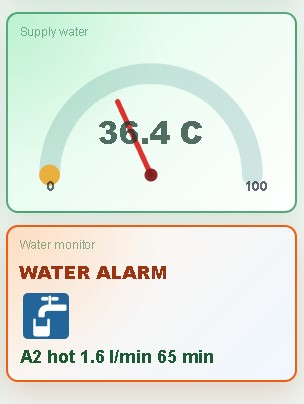
Alarm information can include:
- Site
- Building
- Apartment
- Room
- System
- Device
- Alarm type
- Severity
- Start time
- Acknowledgement
- Resolution
- Duration
- Repeated occurrences
Acknowledging an alarm and resolving the underlying condition are deliberately different events.
Historical alarms remain available for analysis.
This allows the system to answer questions such as:
Which property generates the most alarms?
Which apartment repeatedly has climate problems?
Which device produces recurring warnings?
Which alarms last the longest?
Is a problem isolated, or has it happened 30 times this month?
The system reports the pattern.
The operator can then investigate the cause.
Professional Control Room
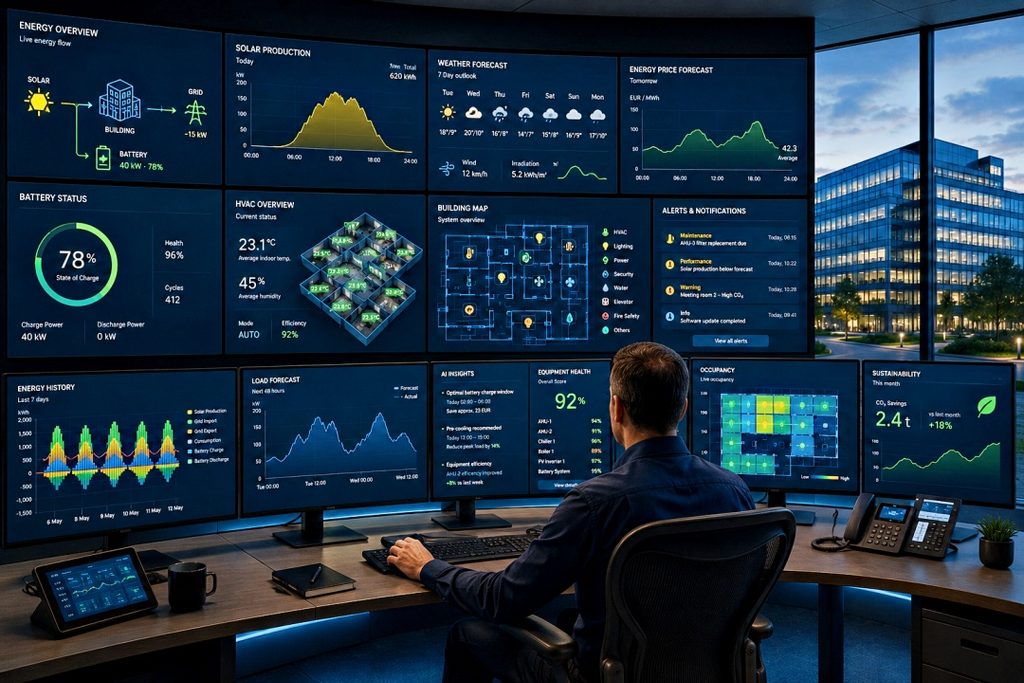
For property operators, service companies and organizations responsible for multiple buildings, Lite Lion extends naturally into a professional multi-site Control Room.
Instead of opening individual building systems one by one, operators can supervise an entire portfolio from a common operational view.
The Control Room can provide:
- Site, apartment and room-level investigation at.
- Multi-site monitoring
- Responsive site overview
- Site priority management
- Live site status
- Active alarm indication
- Automatic promotion of alarm sites
- Warning status
- Offline detection
- Search
- Status filtering
- Flexible monitor views
- Multi-monitor operation
- Site Focus View
- Active Alarm management
- Alarm acknowledgement
- Permanent Alarm History
- Alarm analysis
- Recurring alarm identification
- Problem hotspot analysis
- Alarm duration statistics
- Operational reporting
- CSV reporting
The Control Room is designed to remain practical whether the operator supervises ten properties or hundreds.
Different monitors can perform different jobs.
One can keep priority sites continuously visible.
Another can automatically rotate through the wider property portfolio.
A third can display the detailed dashboard of a building currently requiring attention.
If an important alarm occurs, the affected site can be brought immediately to the operator’s attention instead of waiting quietly on page four.
From One Home to Hundreds of Buildings
The scale can change dramatically without changing the basic philosophy.
At home
Start with:
Lite Lion Home
Gateway
a few Temperature/Humidity Monitoring Units
Relay Module
That is already enough to create the foundation of a highly capable modern smart home at surprisingly modest hardware cost.
Add more only when you want it.
In an advanced home
Add:
Additional automation
Solar PV
Battery storage
Dynamic electricity prices
Predictive energy management
Heating control
More rooms
Advanced LED lighting
CCT / RGB / RGBW
Sensors
In an apartment building
Add:
- Apartments
- Room-level climate
- Heating systems
- Domestic hot water
- Energy history
- Alarm history
- Property-level reporting
In commercial property
Expand into:
- More extensive alarms and reporting
- Larger energy systems
- Building-wide automation
- Peak-power management
- Lighting systems
- Technical equipment
- Operational history
For professional operators
Add:
Lite Lion Control Room
and supervise many independent properties from one operational environment.
The installation grows.
The technology does not have to start over.
A Building That Becomes More Understandable With Time
The ultimate purpose of smart building technology is not to create more screens, more controllers or more blinking boxes.
It is to make the building easier to understand and better able to respond.
Lite Lion brings together:
- Measurement
- Control
- History
- Learning
- Forecasting
- Prediction
- Automation
- Energy optimization
- Alarms
- Professional supervision
into one expandable environment.
A small installation can begin with a gateway, a sensor and a relay.
A sophisticated installation can combine energy markets, solar production, batteries, heating, room climate, advanced lighting, distributed automation and multi-site supervision.
And because the system can use both historical behaviour and information about what is likely to happen next, automation can gradually move from simply reacting to events toward anticipating them.
Build Your Lite Lion System
Explore the two sides of the Lite Lion platform:
Building Automation Licenses
Choose the license according to the type and scale of your property, from a single home to large commercial and multi-property installations.
Automation Hardware
Choose gateways, Modbus and RS485 modules, relay modules, sensors, PWM and lighting interfaces, communication equipment, power supplies, converters and accessories.
Start small. Connect what matters. Learn how the building behaves. Expand when you need more.
Available soon!